
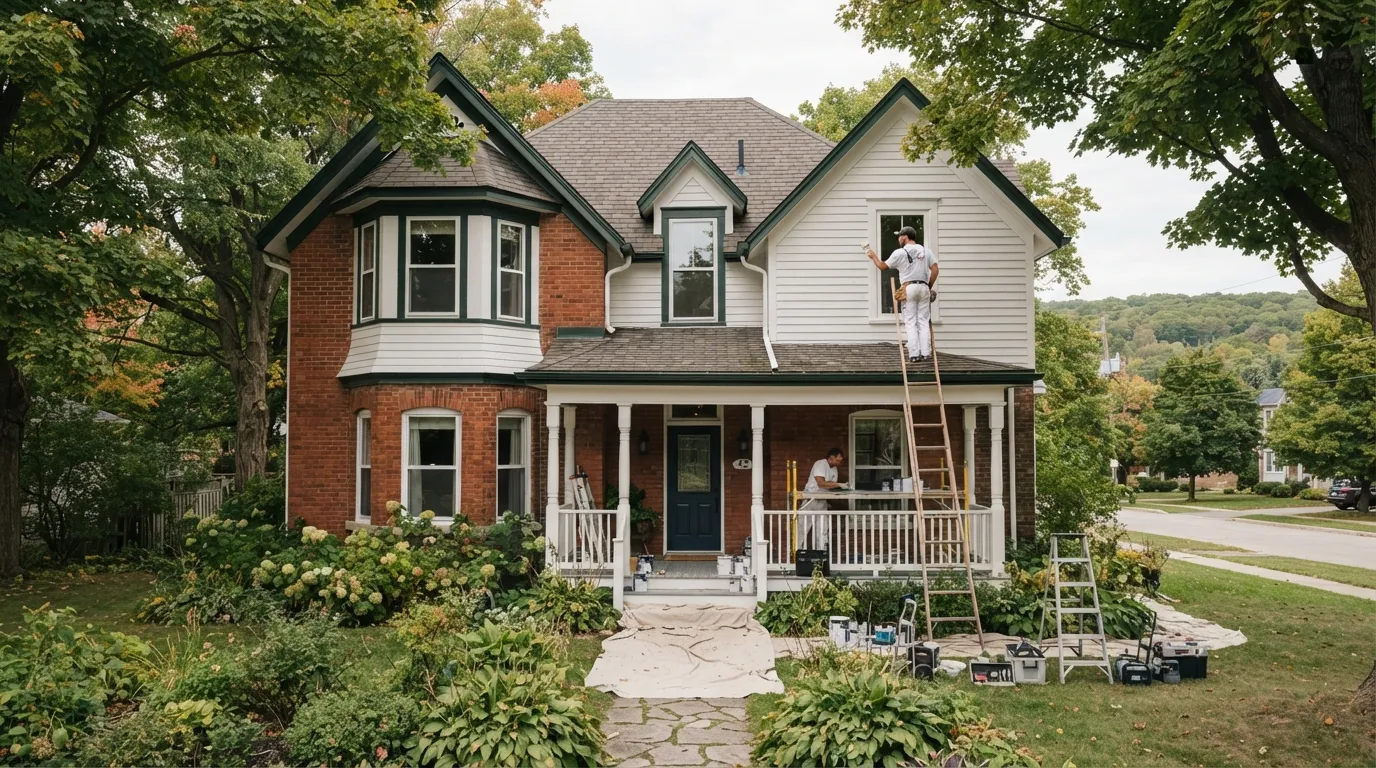
Careful repaint of a century home in Caledon
Heritage clapboard, layered lead paint, and tight eaves—restore the house without harming its character.
- 1
Step 1 — Tests and teardown
We started with a lead-paint swab and moisture mapping. Where tests indicated lead, we used encapsulation and HEPA vacuuming during hand-scraping rather than full chemical stripping. Rotting boards and failed trim were cut out and replaced with matching pine mouldings, back-primed before install.
- 2
Step 2 — Prep that lasts
Prep is half the life of the paint. We calked gaps with a paint-grade hybrid sealant compatible with both wood and trim, feathered edges with medium-grit sanding, and applied a tannin-blocking primer on knots and areas with old sap/bleed. All fasteners were checked and swapped to stainless or hot-dipped galvanized where appropriate.
- 3
Step 3 — Breathable primers and topcoats
For the main clapboard we used an alkyd-modified acrylic primer on new wood and an acrylic latex primer on existing sound areas to balance adhesion and breathability. Topcoats were 100% acrylic, high-build exterior formulations with UV inhibitors and a mildew-resistant mildewcide — chosen for Ontario’s freeze-thaw cycles and summer humidity.
- 4
Step 4 — Trim and detail work
We sprayed larger surfaces for uniformity, then tipped by brush at edges and trim to ensure coverage in mouldings. Cornice returns, window sills, and eaves got two finish coats; decorative brackets and turned posts were hand-painted with a slightly glossier enamel for durability at wear points.
- 5
Step 5 — Clean site and documentation
After curing, we removed scaffolding and did a HEPA sweep where lead work occurred. We left the owners a care sheet: manufacturer data sheets for the primer and topcoat, fastener lists, and recommended maintenance intervals for the local climate.
Frequently Asked Questions
How long will a repaint like this take?
Typical timeline is a few weeks of onsite work for a two-storey century house: testing and prep take the longest. Weather in Caledon matters—we avoid painting in heavy rain, below-freezing temps or during extreme heat, so seasonal windows can stretch the calendar.
How disruptive is the work to daily life?
We keep disruption low. Scaffolding is compact, we stage materials off the street where possible, and we do noisy work during standard daytime hours. Because we do lead-safe prep when required, there are containment steps that the homeowner should expect for dust control.
When does an older home need a full repaint rather than spot touch-ups?
Look for widespread peeling, wood rot, failing flashing, or moisture staining—those signal systemic issues. If multiple layers are flaking or the substrate is compromised, a full system (prep, primer, two coats) is the right, longer-lasting choice.
Ready to restore your Caledon home the right way?
Email us with photos and your address details. We’ll plan a practical approach that respects heritage and the Ontario climate.
Get a Free Quote